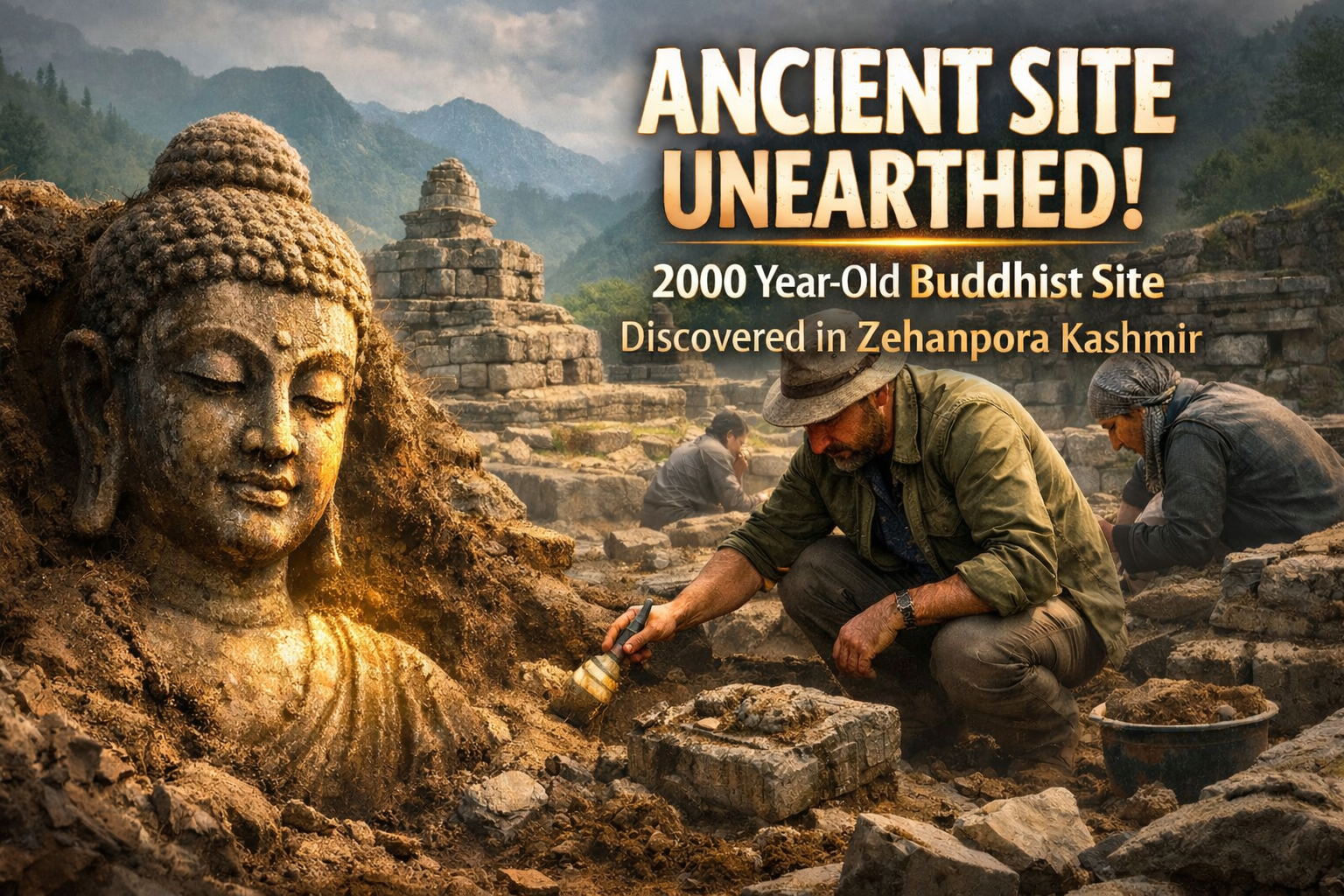
History has a funny way of hiding in plain sight. For generations, the villagers of Zehanpora Baramulla went about their daily lives, tending to apple orchards and rice paddies, all while walking over the secrets of a 2,000-year-old civilization.
While locals always knew the strange, grass-covered mounds in their backyard were “something,” it took a serendipitous discovery thousands of miles away in France to prove that these weren’t just hills but were the heart of an ancient Buddhist empire.
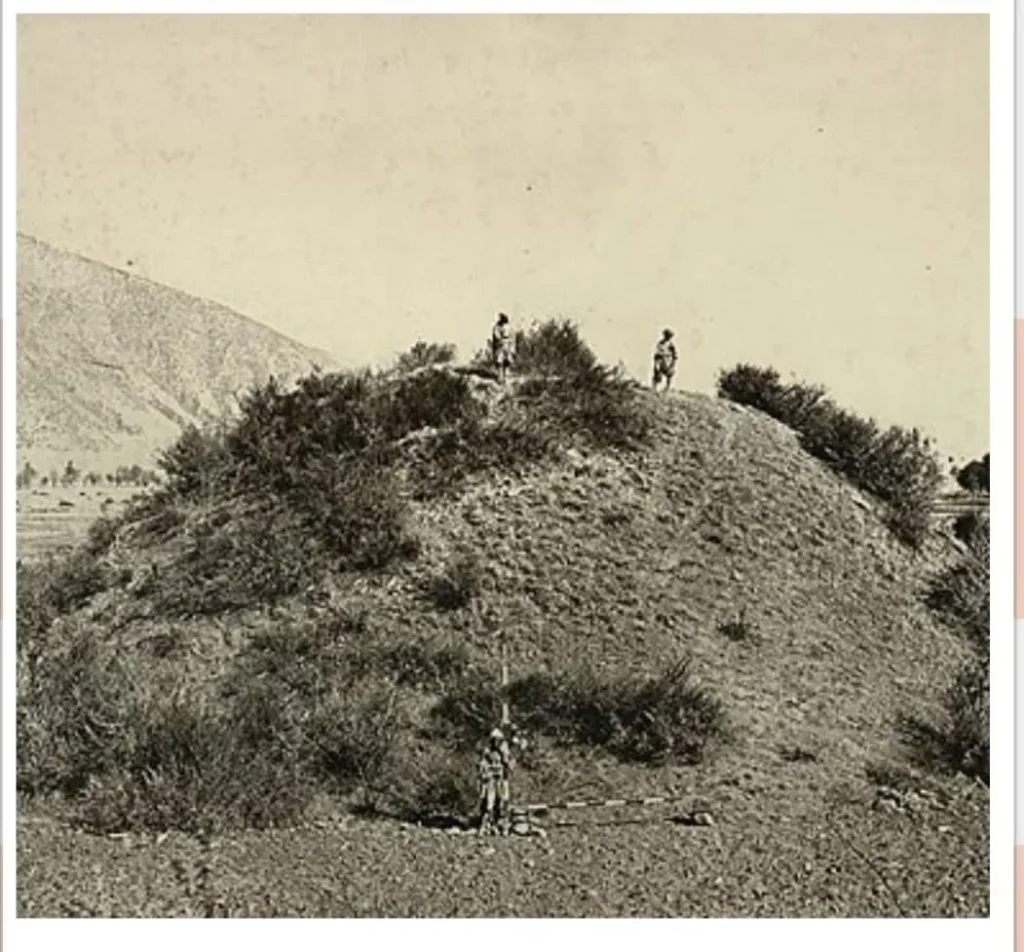
This general view of the unexcavated Buddhist stupa near Baramulla, with two figures standing on the summit, and another at the base with measuring scales, was taken by John Burke in 1868.
Table of Contents
A National Spotlight: Prime Minister Modi’s “Mann Ki Baat”
This discovery recently gained national attention when Prime Minister Narendra Modi highlighted it in his December 2025 address of Mann Ki Baat. He shared how the mystery of these “ordinary mounds” was finally solved through a mix of local grit and international archives.
The Prime Minister remarked that the story of Zehanpora Baramulla is a “saga of pride,” illustrating how Kashmir’s history is far deeper than its scenic beauty. He pointed out that while the mounds were ignored for decades, the breakthrough came from an old, grainy photograph preserved in a French museum. This visual evidence, he noted, helped “turn the course of discovery,” proving that Kashmir was a central hub for Buddhist learning nearly two millennia ago.
A Digital Bridge to the Past
The real “Eureka” moment happened when Dr. Mohammad Ajmal Shah, an archaeology professor from the University of Kashmir, stumbled upon those photographs in the French archives. Despite their blurriness, the images clearly depicted three Buddhist stupas located in Baramulla.
These photos acted as a historical GPS. They provided the definitive proof needed to link the physical mounds in Zehanpora to the vast Gandhara Buddhist network that once stretched across Central Asia.
What’s Emerging from the Earth?
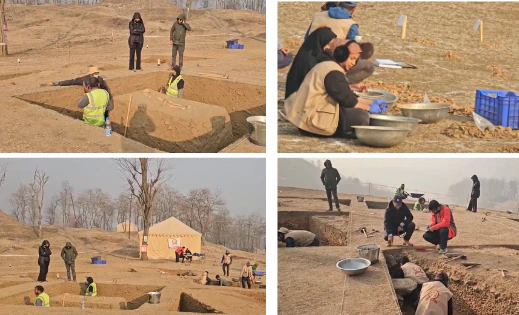
Since the systematic excavation kicked off in mid-2025, the site has transformed into a time machine. Using a mix of high-tech drone mapping and traditional shovel-and-brush work, archaeologists have unearthed:
- Apsidal Stupas: These are unique, semi-circular shrines designed for pradakshina (circumambulation), where ancient devotees would walk in prayer.
- Kushan-Era Treasures: Shards of pottery and copper artifacts dating back to the 1st–3rd centuries CE, a time when the Kushan Empire was a superpower of trade and culture.
- Urban Settlements: Remains of chaityas (prayer halls) and viharas (monasteries) that suggest Zehanpora wasn’t just a religious site, but a bustling hub of scholars and monks.
Echoes of the Silk Route
The discovery confirms what legendary travelers like the Chinese monk Xuanzang (Hiuen Tsang) wrote about nearly 1,400 years ago. In his travelogues, he described entering the valley via the Silk Route and finding a land flourishing with Buddhist thought.
By situating Zehanpora along this ancient highway, we now see Kashmir not as a remote mountain valley, but as a central “intellectual station” where ideas from India, Greece, and Central Asia collided.
“The work at the site is a matter of pride… we are finally seeing the ‘urban-type’ settlements that literary sources only hinted at.” — Javaid Ahmed Mattoo, Excavation Assistant
Why This Matters Today
This isn’t just about old rocks and broken pots. It’s a reminder of Kashmir’s role as a global crossroads. The collaboration between the University of Kashmir and the Department of Archives, Archaeology and Museums marks a new chapter in local heritage, one where modern technology finally catches up to ancient legends.
As the excavation moves into its next phase, the valley expects to find even more. For now, the next time you look at a blurry old family photo, remember: it might just be the key to a forgotten kingdom.
Read also : Kashmiri walnut wood carving and its styles